Hello world: Writing to stdout with indirect syscalls
Most programs call printf and stop thinking about it. This post does the opposite.
The goal is a hello-world program for Windows that calls NtWriteFile directly. On any sane OS that would be straightforward: look up the syscall number, load it into the right register, hit syscall. Windows makes it harder. The kernel has no stable syscall ABI; service numbers (SSNs) change between versions and patch levels, so nothing can be hardcoded.
And even once you have the SSN, you can’t just emit a syscall instruction inside your own binary, if you play competitive video games, you most likely have kernel anti-cheat drivers which use APC-based stack inspection to flag return addresses that don’t belong to any loaded module, which would include yours.
Those two constraints are what the rest of the post is about: resolving the SSN at runtime and dispatching it through a gadget inside ntdll rather than from your own code.
The starting point was this video by leetCipher. I wanted to work through it properly, strip most of the SDK dependencies, and understand each piece well enough to explain it.
The post assumes some passing familiarity with C and Win32 or Windows internals. I have tried to explain each concept before using it, so neither is a hard requirement; but both will make the PEB walking and SSN extraction sections considerably less surprising.
Walking the PEB
The SSN can’t be hardcoded, so it has to be resolved at runtime. It lives inside ntdll, which means the first thing needed is ntdll’s base address. The obvious approach would be to call GetModuleHandle("ntdll.dll"), but that means using Win32, which defeats the point. We have to read it out of the process’s own bookkeeping structures.
Every Windows process has a PEB (Process Environment Block) that the loader maintains. The PEB contains Ldr->InMemoryOrderModuleList, a doubly-linked list of every module loaded into the process. The first entry is the process executable itself; ntdll.dll follows in second position, since it is the first DLL the loader maps before anything else runs. The address of the PEB is in the TEB (Thread Environment Block), which is directly accessible via GS:[0x30] on x64 (or FS:[0x18] on x86).

Parsing the export directory
With ntdll’s base address, the next step is locating NtWriteFile’s stub. The PE export directory gives a way to do this by name without any API involvement.
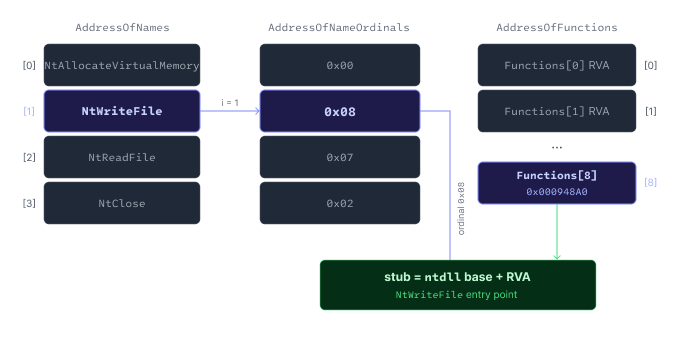
The export directory has three parallel arrays: AddressOfNames (function name strings), AddressOfNameOrdinals (index into the RVA array), and AddressOfFunctions (RVAs). Walk AddressOfNames, find the entry that matches NtWriteFile’s hash, use the matching ordinal to index AddressOfFunctions, add the image base. That’s the stub address.
RVAs mean Relative Virtual Addresses. They represent the memory offset of an item (like a function, variable, or section) inside a loaded executable file, calculated as the distance from the file’s base load address.
Extracting the SSN
The stub address is the function pointer, but what’s needed is the SSN (syscall number) embedded inside it. An unhooked x64 Nt* stub has a fixed layout:
4C 8B D1        mov r10, rcx    ; kernel syscall ABI: arg0 goes in r10
B8 08 00 00 00  mov eax, 0x08   ; SSN (varies per build)
0F 05           syscall
C3              ret
If the first four bytes are 4C 8B D1 B8, the stub is clean and the SSN is at offset 4. If they’re not (typically E9 (a near JMP) at byte 0 or byte 3), something has patched it, most likely an EDR redirecting execution to a trampoline. In that case the SSN can’t be read directly.
The fallback is neighbor scanning (as seen in Tartarus’ Gate): walk adjacent stubs up and down until one is unhooked, read its SSN, then infer the target’s SSN via offset. Adjacent Nt* stubs have consecutive SSNs, and on x64 each stub is exactly 32 bytes, so if the neighbor at distance n has SSN k, the target’s SSN is k ± n.
for (WORD wIdx = 1; wIdx <= 500; wIdx++) {
    if (NeighborSSN(pbStub, wIdx, DOWN, pdwSSN) || NeighborSSN(pbStub, wIdx, UP, pdwSSN)) {
        *ppvGadget = ScanGadget(pbBase);
        return *ppvGadget != NULL;
    }
}
Finding a gadget
With the SSN in hand, the obvious next move is to load it into eax and hit syscall. The problem is where that instruction lives.
A syscall emitted inside your own binary means the kernel will eventually return to an address inside your binary. Now back to the video games topic; kernel anti-cheat drivers (such as BattlEye’s BEDaisy.sys) use Windows Asynchronous Procedure Calls (APCs) to periodically inspect running threads in the protected process. An APC fires in the target thread’s context, calls RtlWalkFrameChain to capture the return address chain on the stack, and checks each address against the loaded module list. A return address that doesn’t fall within any module’s [base, base + size) range is flagged as suspicious. Your binary almost certainly isn’t in that list.
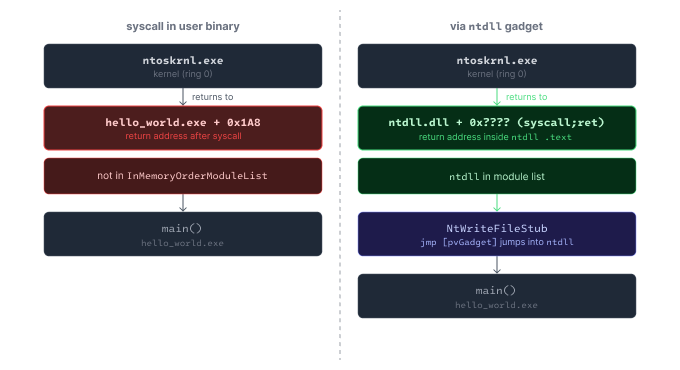
The solution is a gadget: a syscall; ret sequence (0F 05 C3) that already exists inside a legitimate, loaded DLL. Jump into it instead of emitting the instruction yourself, and the return address the kernel sees belongs to that DLL. In this case, ntdll, which is always loaded and always passes the membership check.
PIMAGE_DOS_HEADER     pDos = (PIMAGE_DOS_HEADER)pbBase;
PIMAGE_NT_HEADERS     pNt  = (PIMAGE_NT_HEADERS)(pbBase + pDos->e_lfanew);
PIMAGE_SECTION_HEADER pSec = IMAGE_FIRST_SECTION(pNt);

for (WORD wIdx = 0; wIdx < pNt->FileHeader.NumberOfSections; wIdx++, pSec++) {
    if (*(DWORD*)(pSec->Name + 1) != 'txet') {
        continue;
    }

    BYTE* pbStart = pbBase + pSec->VirtualAddress;
    BYTE* pbEnd   = pbStart + pSec->Misc.VirtualSize - 2;
    for (BYTE* pb = pbStart; pb < pbEnd; pb++) {
        if (pb[0] == 0x0F && pb[1] == 0x05 && pb[2] == 0xC3) {
            return pb;
        }
    }
}

return NULL;
One caveat: the module list APCs consult is typically derived from
Ldr->InMemoryOrderModuleList, which kernel-mode cheats can patch directly. That’s not a concern here, but it’s why production anti-cheat designs don’t rely on the PEB list exclusively. The full mechanics of the technique are covered by klezvirus; the APC stack inspection mechanism is documented in more detail in how kernel anti-cheats work.
The syscall stub in MASM
SSN and gadget address are both known. The dispatch itself is three instructions. The mov r10, rcx is mandatory: the Windows x64 syscall ABI requires the first argument in r10 when entering the kernel, not rcx as per the normal Win64 calling convention.
EXTERN dwSSN:DWORD
EXTERN pvGadget:QWORD

.code
    NtWriteFileStub PROC
        mov     r10, rcx
        mov     eax, DWORD PTR [dwSSN]
        jmp          QWORD PTR [pvGadget]
    NtWriteFileStub ENDP
end
mov eax, ... on x64 implicitly zeroes the upper 32 bits of rax, so the full register holds just the SSN by the time syscall reads it.
Calling NtWriteFile
With the stub wired up, calling NtWriteFile is mostly parameter plumbing.
NtWriteFile takes 9 parameters. Most are optional for a console write; you can pass NULL for the event handle, APC routine, APC context, byte offset, and key (see NtWriteFile on ntdoc). The one you can’t skip is IoStatusBlock: the kernel writes the result into it, so it has to be a valid address.
DWORD dwSSN    = 0;
PVOID pvGadget = NULL;

int main(void) {
    const char      szMsg[]       = "Hello world!\n";
    IO_STATUS_BLOCK ioStatusBlock = {0};
    NtWriteFile_t   pfnWriteFile  = (NtWriteFile_t)(void*)NtWriteFileStub;
    NTSTATUS        lStatus;

    if (!ResolveNtWriteFile(GetNtdllBase(), &dwSSN, &pvGadget)) {
        return 1;
    }

    lStatus = pfnWriteFile(
        GetStdoutHandle(),
        NULL,
        NULL,
        NULL,
        &ioStatusBlock,
        (PVOID)(ULONG_PTR)szMsg,
        sizeof(szMsg) - 1,
        NULL,
        NULL
    );

    return lStatus < 0 ? 1 : 0;
}
Shrinking the .exe
The program works. The next challenge I set myself was to get the binary as small as possible.
On Linux you can strip an ELF down to almost nothing. PE files have a harder floor. FileAlignment means every section costs at least 512 bytes on disk regardless of how little it holds. Without any size work, the linker produces four of them:
Name     VirtualSize   RawDataSize
.text    0x23C (572)          1024
.rdata   0xB4  (180)           512
.data    0x10   (16)             0
.pdata   0x18   (24)           512
Total on disk: 3072 bytes
.rdata is read-only data (string literals, import thunks). .pdata is the structured exception handling table the compiler emits for every function on x64, for the Windows stack unwinder. Four sections with barely anything in them still occupy 4 × 512 = 2,048 bytes on disk minimum. The actual code is a rounding error by comparison.
MSVC doesn’t give you a clean way out of this. The unwind tables are enforced, and the linker leaves enough COFF overhead that the floor stays high. Switching to clang-cl and lld-link opens up flags that actually do the job:
$CFlags = @("/Os", "/GS-", "/Gy", "/Gw", "/EHa-", "/clang:-fno-asynchronous-unwind-tables")/Os optimizes for size over speed. /GS- removes the stack cookie check. /EHa- disables exception handling, which otherwise forces the compiler to emit cleanup tables. /Gy and /Gw emit each function and global into its own COMDAT section so the linker can discard unused ones. -fno-asynchronous-unwind-tables reduces how much .pdata lld synthesizes from CFI at link time — though it can’t eliminate it entirely, because lld regenerates unwind entries from CFI regardless of what the .obj files contain.
The linker flags finish the job:
$LdFlags = @(
    "/subsystem:console"
    "/nodefaultlib"
    "/entry:main"
    "/merge:.rdata=.text"
    "/merge:.pdata=.text"
    "/out:$Target"
    ...
)
/nodefaultlib drops the CRT entirely. /entry:main skips the CRT startup wrapper. The two /merge flags collapse .rdata and .pdata into .text, taking care of three alignment boundaries. That last merge is the only way .pdata actually disappears from the PE; no compiler flags reaches it once lld has rebuilt it at link time.
Result: 1,536 bytes.
Conclusion
The chain looks like this in hindsight: no stable ABI forces runtime SSN resolution, which requires finding ntdll without Win32, which means the PEB. The SSN is in the stub bytes (assuming no EDR has patched them, and if one has, neighbor scanning recovers it). Then the APC stack inspection problem forces the gadget approach (only if kernel anti-cheats are running), which means scanning ntdll’s .text section rather than emitting syscall locally.
Code is at MihaiStreames/hello-world-overkill.
References
- leetCipher. “Hello World in 300 lines of code to piss off vibe coders.” YouTube. https://www.youtube.com/watch?v=4VeYn3MgilU
- klezvirus. “Callback hell: abusing callbacks, tail-calls, and proxy frames to obfuscate the stack.” 2025. https://klezvirus.github.io/posts/Callback-Hell
- trickster0. “Halo’s Gate Evolves to Tartarus Gate.” 2025. https://trickster0.github.io/posts/Halo’s-Gate-Evolves-to-Tartarus-Gate/
- s4dbrd. “How Kernel Anti-Cheats Work: A Deep Dive into Modern Game Protection.” 2026. https://s4dbrd.github.io/posts/how-kernel-anti-cheats-work
- m417z. “NtWriteFile.” ntdoc. https://ntdoc.m417z.com/ntwritefile